
Air Filters for Cigarette Smoke: Complete Guide 2026
Most guidance on air filters for cigarette smoke explains particle capture well, but often skips the gas side of the problem. A purifier with HEPA filtration can reduce visible haze, yet if it lacks substantial gas-phase carbon, the room may still smell like smoke and people may still be exposed to gases that particle filters cannot capture.
In real buildings, that gap causes frustration. Teams buy for the visible smoke, then wonder why odours remain, complaints continue, and filters seem to wear out faster than expected. Cigarette smoke is not just a dust problem. It is a combined particle and gas load, and it has to be treated that way.
Table of Contents
Why Most Air Purifiers Fail Against Cigarette Smoke - The part you can see is only half the issue - Why consumer labels can be misleading
Understanding Cigarette Smoke Composition - Particles are the visible load - Gases need a different capture mechanism - Why this changes buying decisions
The Multi-Stage Filter Train Approach - What each stage is doing - How to read the spec sheet
How Cigarette Smoke Degrades Filter Performance - Electrostatic media are vulnerable - Replacement planning has to be smoke-specific
Sizing Air Purifiers for Smoke-Heavy Environments - CADR is the number that matters - A practical sizing guide - The noise trade-off is real
Combining Filtration with Ventilation and Source Control - Ventilation still matters - Source control is the strongest lever - Where filtration fits best
Making Smart Purchasing Decisions for Smoke Filtration - What to verify before you buy - Total cost of ownership is the real cost
Why Most Air Purifiers Fail Against Cigarette Smoke
Many air purifiers only solve half the problem. Cigarette smoke contains visible particles and invisible gases, and those two contaminants require different filtration methods. If a unit clears the haze but leaves the smell behind, it has improved the room, but it has not fully solved the smoke issue.
The part you can see is only half the issue
Visible smoke is the easier part to remove because it is particulate. In long-duration chamber tests in smokers' homes, adequately sized room air filters reduced particulate matter by 30% to 70%, depending on particle size and occupant activity. They also shortened the half-life of fine particles in the 0.3–1.0 μm range. The same study found no meaningful change in carbon dioxide, larger particle half-life, or cigarette-smoke VOC tracers, showing that the filters reduced particles without changing smoking behaviour or ventilation. Study on room air filters in smokers' homes
This is the practical divide buyers need to understand. HEPA and high-MERV filters can reduce airborne smoke particles very effectively, but they do not remove smoke gases. A purifier can make a room look cleaner much faster than it makes the room smell cleaner.
Why consumer labels can be misleading
Many consumer units are marketed as smoke solutions when they are really particle-control devices. That can be helpful if the goal is to reduce visible haze, but it is often not enough in clinics, offices, senior care spaces, and multi-unit buildings where odour complaints are a major concern.
Practical rule: if the product spec only highlights HEPA or CADR, assume it is mainly solving the particle side of smoke.
That is why air filters for cigarette smoke need a broader spec than a standard allergen purifier. The real question is not simply whether the unit filters air. It is whether it reduces both the visible haze and the gaseous odours and VOCs that linger after the haze is gone. If the carbon stage is vague, minimal, or treated like a footnote, the unit is probably not designed for tobacco smoke.
Understanding Cigarette Smoke Composition
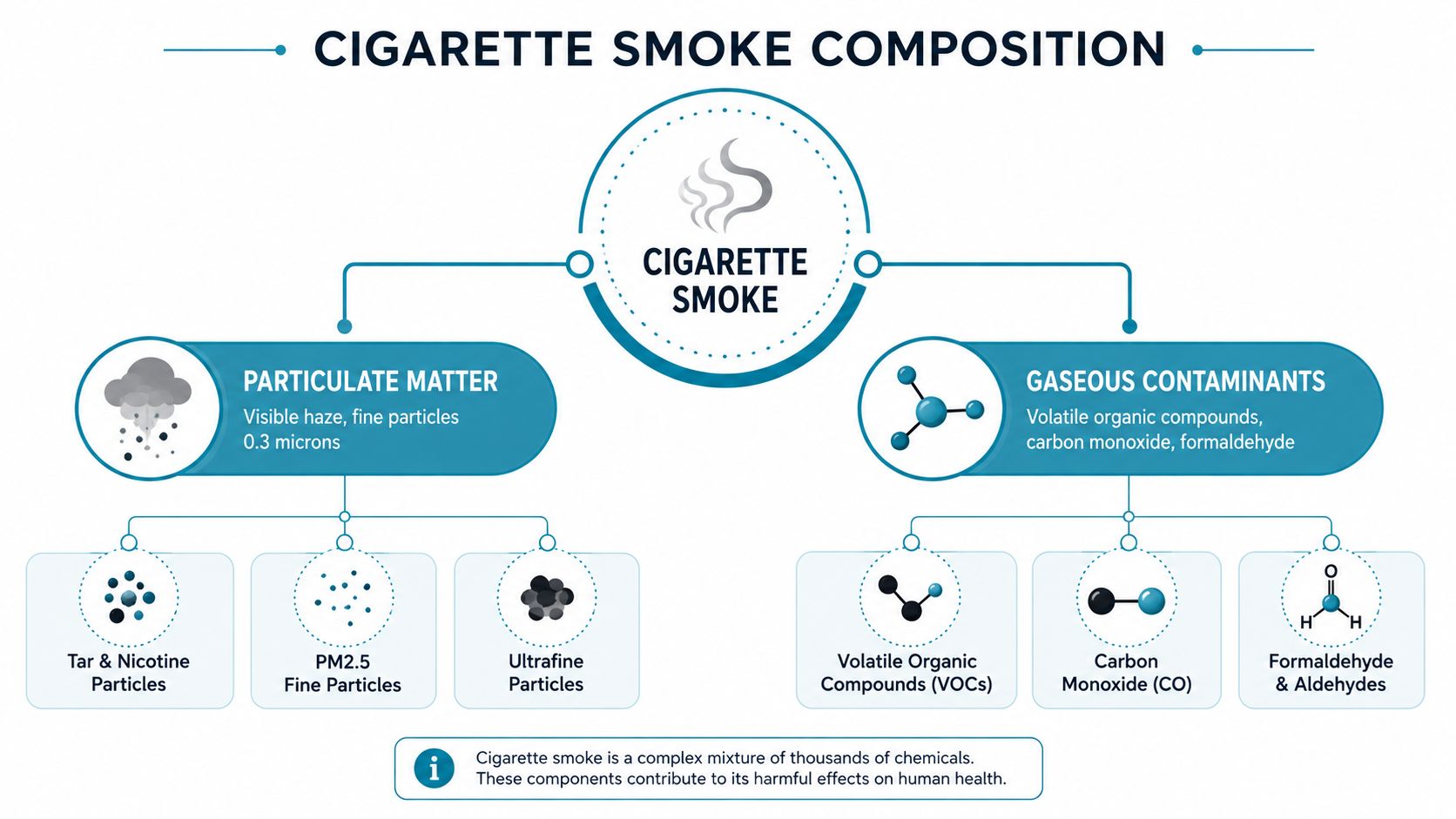
Cigarette smoke is a mixed contaminant stream, not a single pollutant. The visible cloud is mostly fine particulate matter, while much of the lingering smell and chemical exposure comes from gases. That difference matters because the capture method for one does very little for the other.
Particles are the visible load
The haze people notice first is made up largely of fine particles that can stay suspended in the air. That is why a room may look clearer after purification while still carrying a stale smoke smell. Mechanical filters are built for this part of the job, and their performance depends on both particle size and airflow.
This is where MERV 14 to 16 media, and in some cases HEPA, play an important role. They target the fine particulate fraction that makes smoke visible and irritating.
Gases need a different capture mechanism
The odour that remains after the haze clears comes from gaseous contaminants, especially VOCs. Mechanical filters are not designed to hold those molecules for long. To reduce smoke odour and gas-phase contaminants, you need adsorption media, usually activated carbon.
Smoke particles are like sand. Gases are like perfume. A sieve catches sand, but perfume passes through.
That is the core design issue. A purifier without meaningful carbon may reduce visible smoke and still leave most of the smell in place. In a care home lounge, office suite, or reception area, that often determines whether people think the purifier works.
Why this changes buying decisions
Once you separate particles from gases, product claims become easier to judge. A high-efficiency particle filter can be genuine and still be the wrong answer if odour is the main complaint. A carbon-heavy system can help with smell, but it still needs a particulate stage for the haze. Effective air filters for cigarette smoke have to do both jobs.
The Multi-Stage Filter Train Approach
The most dependable smoke-control setup uses a three-stage filter train. Start with a prefilter for larger debris, add a particulate stage for the fine smoke, then finish with substantial carbon for odour and VOCs. That approach appears in commercial tobacco-smoke guidance because no single medium handles the full contaminant load. For a practical comparison, see find the best filtration system, especially if you are comparing particle-only products with units that include gas-phase media.
What each stage is doing
The first stage is the low-cost protector. MERV 6 to 8 prefiltration captures lint and larger soot, which helps protect the finer downstream media and slows premature loading. The second stage handles the fine smoke fraction, using MERV 14 to 16 or HEPA for particles in the 0.3–1.0 μm range.
The third stage is where many consumer units fall short. A thin carbon pad has very limited adsorption capacity, so it may reduce the initial smell briefly and then stop making much difference. For meaningful smoke odour control, the carbon bed needs enough depth and mass to matter, not just a mention on the spec sheet. For a practical example, see the Castus Filter Set Photocatalyst Activated Carbon at https://www.castus.ca/product-page/castus-filter-set-photocatalyst-activated-carbon.
How to read the spec sheet
Do not treat the phrase "carbon filter" as enough information. Ask how much carbon the unit contains, how deep the bed is, and how long the media is expected to remain effective under tobacco loads. A buying guide used by Canadian facilities points to at least 1.2 kg of granular or pelletized carbon and about 5 cm or more carbon depth for useful odour control. The same guidance recommends planning around 4 air changes per hour (ACH) and using CADR = room volume × 4 ÷ 60 to size the unit. Technical buying guide on smoke odour control
Stage | What it handles | Why it matters |
|---|---|---|
Pre-filter | Lint, larger soot | Protects downstream media |
Particulate stage | Fine smoke particles | Clears haze and visible smoke |
Carbon stage | Odour, VOCs | Addresses the smell that particle filters miss |
For facilities that want a packaged option, a multi-stage system such as the Castus Filter Set Photocatalyst Activated Carbon can be worth considering, as long as the installed unit matches the room load and the replacement schedule.
The main lesson is simple. A purifier without a serious carbon bed can reduce haze and still leave the room smelling stale. A unit without a real particulate stage can reduce some odour and still leave visible smoke behind. The specification has to cover both.
How Cigarette Smoke Degrades Filter Performance
Smoke does not just collect on a filter. It can change how the filter performs. That matters because a unit may continue to move air normally while losing a large portion of its capture ability.
Electrostatic media are vulnerable
A 2021 laboratory study on electret air filters found that cigarette smoke can sharply shorten filter life by degrading electrostatic capture. After loading 204 μg/cm² of cigarette smoke onto 100 cm² of filter medium, filtration efficiency in some filters fell from 92.5% to 33.3%, a drop of 59.2 percentage points. The same study reported no corresponding increase in pressure drop, so the filter could still appear mechanically usable while performing far worse. Electret filter degradation study
That is why smoke environments are especially hard on portable purifiers and HVAC cartridges that rely on electret media. If maintenance plans are based on ordinary dust or office loads, they will often underestimate how quickly smoke can reduce performance.
Replacement planning has to be smoke-specific
A smoke-loaded filter that still moves air is not necessarily a filter that is still performing well. In smoke-heavy environments, replacement planning has to be based on exposure, not just on whether the unit still sounds normal or looks acceptable.
A smoke-loaded filter can appear serviceable and still be underperforming.
That makes replacement intervals part of the system design. In heavy smoking areas, the real question is whether the operation has budgeted for a faster filter turnover than a normal dust schedule would require.
The consequence is not just extra filter orders. If staff assume a purifier is still effective because airflow continues, the unit may stay in service long after capture efficiency has dropped. That creates a false economy. For broader maintenance planning, commercial air filter replacement guidance is worth aligning with your internal PM schedule.
Sizing Air Purifiers for Smoke-Heavy Environments
Sizing is where many promising products fail in practice. A strong filter in an undersized machine will not produce enough clean air fast enough to make a noticeable difference. For smoke, room volume and real operating airflow matter more than a brochure headline.
CADR is the number that matters
CADR, or Clean Air Delivery Rate, measures how much cleaned air a unit can deliver. For smoke control, a practical target is about 4 air changes per hour, which is why room volume matters so much. A unit sized for a private office may be completely inadequate for a shared lounge, and a unit that becomes too loud at useful speeds may not stay on long enough to help.
CDC guidance also frames sizing around tobacco-smoke CADR, using 200 CADR as the example for about a 300 ft² room. That reinforces the point that good results depend on matching the unit to the room, not relying on a generic smoke setting. CDC tobacco smoke CADR guidance
A practical sizing guide
Room Size (ft²) | Room Volume (ft³) | Required CADR | Minimum Carbon Mass |
|---|---|---|---|
300 | 2,400 | 160 | 1.2 kg |
600 | 4,800 | 320 | 2.4 kg |
1,200 | 9,600 | 640 | 4.8 kg |
These volume figures assume a standard 8 ft ceiling, which is a better basis for sizing than floor area alone. The carbon recommendation stays the same here because token amounts of carbon rarely provide meaningful odour control, even in smaller rooms.
The noise trade-off is real
In practice, the challenge is not choosing the biggest airflow number. It is choosing a unit that can sustain the required airflow without becoming so loud that occupants or staff shut it off. In clinics, common rooms, and shared spaces, a quieter unit running continuously is often more effective than a louder unit with a higher maximum setting.
That is why one question matters during specification: will people actually leave it running? If the answer is no, the CADR number on paper matters much less. Smoke control works only when the purifier is operating.
For facility buyers comparing room units, best air purifier Canada guidance can help narrow options by capacity and operating considerations.
Combining Filtration with Ventilation and Source Control
Filtration works best as one layer in a broader smoke-control strategy. Even a strong purifier can only clean the air that passes through it. If the smoke source continues feeding the room, or if smoke drifts in from another space, the purifier helps, but it does not solve the whole problem alone.
Ventilation still matters
Air cleaning and ventilation do different jobs. Ventilation removes and dilutes contaminated air, while filtration captures contaminants that remain in circulation. Canadian public health guidance consistently treats ventilation and source control as part of the response to indoor smoke exposure, and that is the right way to think about it.
This matters in multi-unit housing, where smoke can move through gaps, corridors, and shared mechanical pathways. It also matters in senior care settings, where comfort, autonomy, and indoor air quality all have to be balanced realistically.
Source control is the strongest lever
If smoking occurs in a designated indoor area, moving that activity outdoors is the most effective solution. If that is not possible, isolating the source room and exhausting air outward is the next best step. A portable purifier can then help reduce residual particles and odour in adjacent spaces.
For real-world cleanup and odour management, expert advice from Sensitive Environmental is useful because it reinforces the same operating principle. Source control, removal, and post-occupancy cleaning all matter when smoke odour has settled into a space.
Where filtration fits best
In offices, filtration is often most useful in reception areas, smoking-adjacent spaces, or rooms near entrances where occasional exposure occurs. In senior care, it is often most useful in common areas and resident rooms where the building cannot fully eliminate outside smoke infiltration. In each case, the purifier is one layer in a larger control plan.
Realistic goal: reduce exposure and odour enough that occupants stop noticing smoke, not pretend the building has no source issue.
That framing keeps expectations realistic. The more a building can reduce smoke at the source and improve airflow, the less pressure it puts on the purifier.
Making Smart Purchasing Decisions for Smoke Filtration
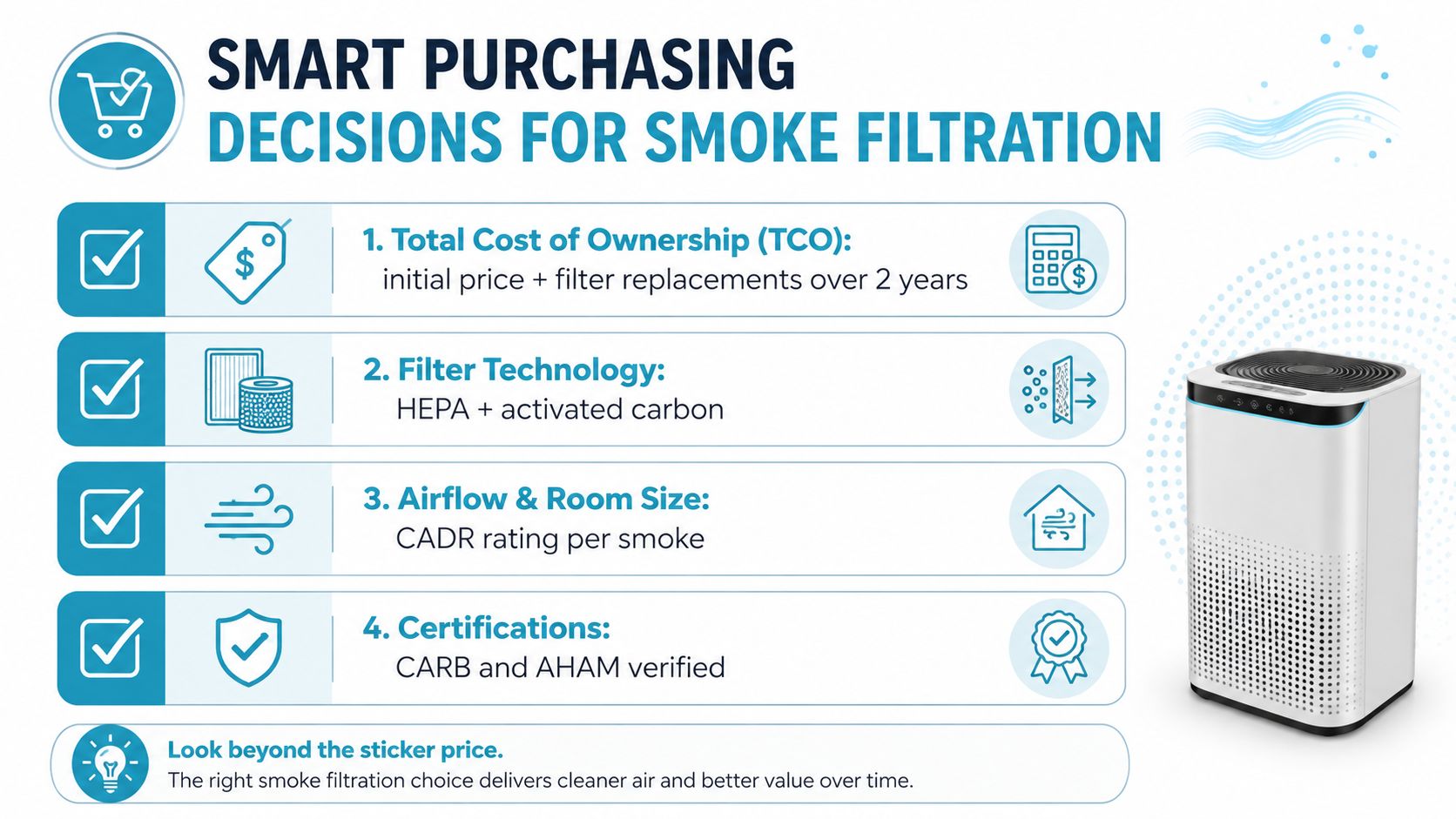
The best purchase is the one that still performs after the first month. For smoke, that means looking beyond sticker price and asking how the unit behaves under real load, how often the media needs replacement, and whether the odour control is substantial or mostly cosmetic.
What to verify before you buy
Particulate stage: genuine HEPA or MERV 14+ capture for fine smoke.
Carbon stage: at least 1.2 kg of granular or pelletised carbon, with around 5 cm of depth if the product is built for odour control.
Airflow match: enough CADR for the room volume and target smoke load.
Maintenance access: replacement filters that staff can source and change on schedule.
Those four checks do more than a brochure. They separate systems built for smoke from units that are really standard allergen purifiers wearing a smoke label.
Total cost of ownership is the real cost
The cheapest purifier can become the most expensive if it needs frequent media changes, runs too loud to leave on, or fails to control odour well enough to stop complaints. The right comparison includes replacement frequency, carbon life, and the labour needed to keep the unit effective.
For a commercial buyer, that is where a vendor like Phoenix HVAC indoor air solutions can be a useful reference point when comparing indoor air system options and installation approaches. The important question is whether the proposed system is designed for smoke loads rather than light-duty air cleaning.
In smoke control, consumer-grade shortcuts usually reappear later as odour complaints, early filter changes, or poor perceived air quality. Facilities that specify for both particles and gases generally get a more reliable result.
If you need help selecting air filters for cigarette smoke for a clinic, office, residence, or care setting, visit Castus to review purification options, replacement filters, and room-sizing support for Canadian facilities.
