
Best Air Purifier Canada: Top Picks for Every Space
In Canada, portable air purifier sales rose 9% in 2020 versus 2019 and reached $136 million in total sales, a clear sign that more households started treating indoor air as a planning issue, not a comfort upgrade. That shift makes the phrase best air purifier Canada less about brand loyalty and more about whether a unit can handle wildfire smoke, sealed winter buildings, and the room you want to clean. On Canadian spec sheets, the numbers that matter are CADR, true HEPA filtration, coverage, and noise, because those are the things that decide whether a purifier helps in real homes and clinics, or just looks good online. CBC News's Marketplace testing and Health Canada's buyer guidance make that point very plainly.
Buying Factor | What to Look For | Why It Matters in Canada |
|---|---|---|
CADR | Strong clean-air output for your room size | Helps with wildfire smoke and closed-window seasons |
True HEPA filtration | Verified filter standard | Supports reliable particle capture |
Coverage | Realistic room match | Prevents underpowered performance |
Noise | Low enough for daily use | Makes continuous operation more likely |
Table of Contents
Why Canadian Buyers Need a Different Approach to Air Purifiers - Wildfire smoke changes the buying brief - Sealed buildings make weak units feel even weaker - Provincial variation raises the stakes
Understanding CADR and Health Canada Buying Guidelines - CADR tells you how much clean air you're actually getting - True HEPA is the specification that matters - Read the spec sheet in this order
Top Air Purifier Models Available in Canada Compared - What the Canadian market really shows - How to compare options without getting distracted
Matching the Right Purifier to Your Specific Space - Bedrooms and studios favour quiet first - Larger shared spaces need more clean-air muscle - Clinics, senior care, and education need different thinking - Match the device to the use case
Total Cost of Ownership Beyond the Purchase Price - Replacement filters change the economics - Energy and noise shape how often you actually run it - Budget traps are usually maintenance traps
When Commercial-Grade Purification Makes Sense - High-risk spaces need more than a single-box solution - Budget and scale have to match the mission
Your Decision Framework for Choosing the Best Air Purifier - Use a simple four-step filter - Separate bedroom logic from smoke logic - Decide with maintenance in mind
Why Canadian Buyers Need a Different Approach to Air Purifiers
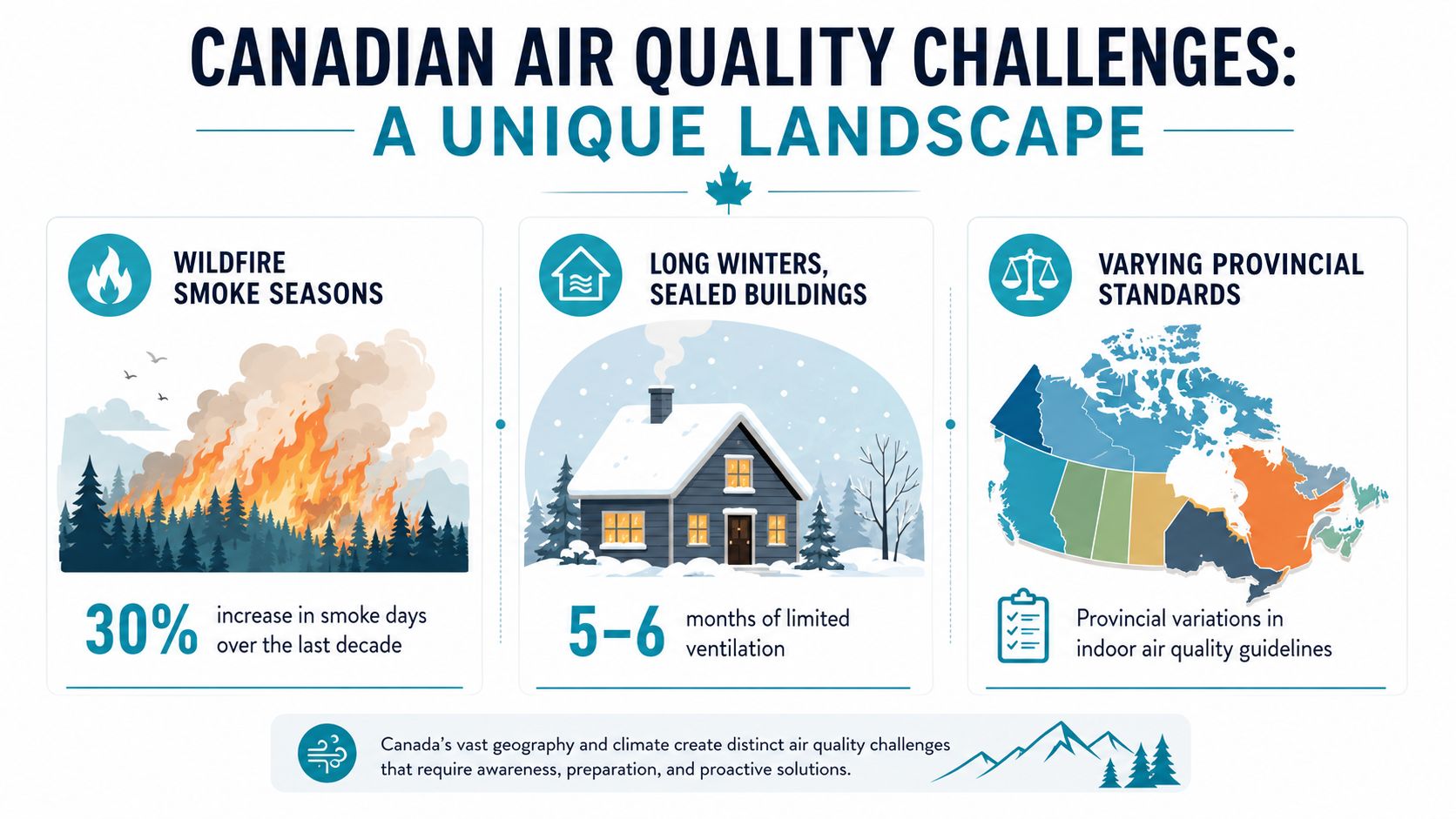
Canada's market does not reward generic air-cleaning advice. A purifier that seems fine in a mild climate can fall short when wildfire smoke pushes fine particles indoors, or when a long winter keeps windows shut and ventilation low for months at a time. That is why Canadian buyers need to focus on measured clean-air output, not polished product claims.
Wildfire smoke changes the buying brief
CBC's reporting on the Canadian market makes the pressure visible. Portable air purifier sales increased 9% in 2020 versus 2019 and reached $136 million in sales, which reflects a lasting change in how many Canadians think about indoor air quality, not a short-lived panic buy. That sales growth also shows why shoppers have become more performance-focused, especially during smoke-heavy seasons. CBC's Marketplace test results show why buyers cannot rely on price alone.
Sealed buildings make weak units feel even weaker
Canadian winters keep people indoors for long stretches, and that makes room coverage a practical constraint. If a purifier is undersized, it cannot keep up with the air volume in the room, no matter how often the marketing copy mentions “fresh air” or “allergen defence.” Health Canada's guidance says buyers should match a unit's CADR to room size and choose a true HEPA filter for the space, because those specifications tell you how quickly a purifier can clean the air and what it can capture. Health Canada is clear on that point.
Practical rule: in Canada, the question is not “Which brand is famous?” It is “Can this unit deliver enough clean air for my room, and can I live with the noise?”
Provincial variation raises the stakes
Indoor air priorities do not feel identical from one province to another, because people experience smoke, winter confinement, and building layouts differently. The smartest Canadian purchases start with the local problem, then work back to the specification sheet. If you want a broader plain-language explanation of those Health Canada principles, the Can Do Duct Cleaning air guide is a useful companion reference.
The infographic's three themes matter because they map to actual buying decisions. Wildfire smoke pushes you toward higher clean-air output. Sealed winter buildings reward units that can run continuously without becoming annoying. Provincial differences make room-by-room judgment more useful than a national bestseller list.
Understanding CADR and Health Canada Buying Guidelines
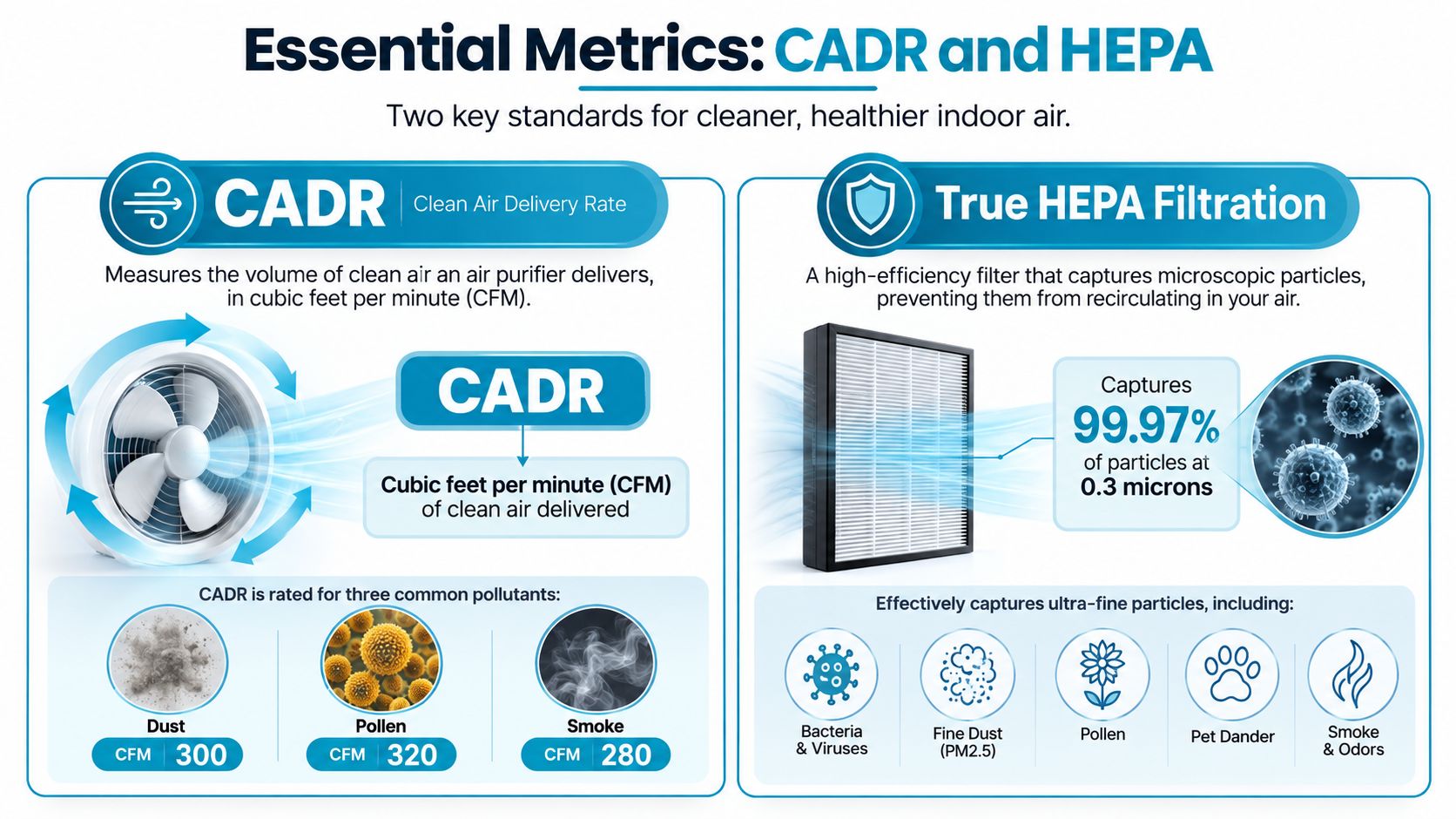
Canadian buyers should start with performance, not packaging. Health Canada's guidance points people toward CADR, room size, and a unit with a true HEPA filter that can move enough air for the space. That matters because a purifier only improves indoor air at the rate its fan and filter can process it, so the number on the spec sheet is more useful than a polished product photo.
CADR tells you how much clean air you're actually getting
CADR, or Clean Air Delivery Rate, measures how quickly a purifier can clean a room's air. A higher CADR means more cleaned air reaches the room each hour, which is what matters in a Canadian home dealing with smoke, closed windows, or a bedroom that needs quiet filtration overnight. CBC's reporting also pointed to a smoke CADR of about 200 to 300 m³/hour as a useful fit for a small to medium room, which gives buyers a concrete reference point instead of a generic “covers many rooms” claim. CBC News
The useful part is the match, not the label. If the CADR is too low, the unit may sound busy while doing too little. If it is higher than the room needs, you can usually run it at a lower fan speed and get cleaner air with less noise, which is a better trade-off for bedrooms, clinics, and other spaces where people stay for long periods.
True HEPA is the specification that matters
Health Canada's advice puts true HEPA ahead of vague marketing language, and that distinction matters in the Canadian market. Words like “medical-grade” or “hospital-style” do not tell you what the filter captures unless the specification is clearly stated. A true HEPA rating gives you a verifiable filter standard you can compare across models and retailers.
A purifier that sounds impressive but leaves out CADR or filter type asks buyers to trust the brand instead of the performance.
Read the spec sheet in this order
Check the room first. Measure the space you want to clean, not the whole floor plan.
Match CADR to that room. Use clean-air output before you look at brand reputation or app features.
Confirm true HEPA filtration. That keeps vague wording from hiding weak filtration claims.
Compare noise last. A purifier that stays off because it is too loud will do less for indoor air than a quieter unit you can run every day.
For readers who want a plain-language companion to federal guidance, the Can Do Duct Cleaning air guide is a useful bridge between Health Canada's framework and day-to-day shopping decisions. Video also helps here, because it shows how fan paths and filters behave once a unit is running in a real room.
The practical takeaway is straightforward. CADR tells you capacity. True HEPA tells you filtration quality. Used together, they give Canadian shoppers a defensible way to compare purifiers before getting distracted by lights, app controls, or marketing copy.
Top Air Purifier Models Available in Canada Compared
Canadian roundup data shows a wide spread in the market. The quiet, compact end looks very different from the higher-output end, and that matters when you are choosing between a bedroom purifier and a unit meant to handle a larger living room or office. The better choice depends on whether you need low noise, broader coverage, or stronger clean-air output.
What the Canadian market really shows
The Canadian market includes compact units for smaller rooms, mid-range units for day-to-day home use, and higher-capacity systems for larger shared spaces. That spread shows why the label best air purifier Canada cannot point to one universal winner. Quiet bedroom use and high-output purification are different jobs, even before you factor in wildfire smoke or a room with poor air circulation.
Marketplace testing still gives buyers a useful lesson. Measured clean-air performance matters more than branding language, and room fit matters more than hype. CBC's test report is the anchor for that comparison.
How to compare options without getting distracted
Coverage is not the whole story. A large square-foot claim does little if the purifier is too loud to keep running.
Noise affects real-world use. A quieter machine is far easier to live with in a bedroom than a louder unit you keep switching off.
CADR is the performance anchor. The Canadian market rewards shoppers who compare actual clean-air delivery instead of packaging language.
The internal review at Castus air purifier is relevant if you are comparing consumer units with a more facility-oriented approach, because it shows how room sizing and filtration choices are handled in a business context. That is useful even for homeowners, because the same logic applies when the space gets larger or the air-quality problem is more persistent.
If you are researching infection-control-focused products, the VirusFAQ roundup of virus-proof air purifier models can help you see how some marketers frame virus-related claims, but you still need to verify the actual specifications on any model you are considering.
Buying Factor | What to Compare | Why It Matters |
|---|---|---|
Coverage | Room size match | Prevents underperformance in larger spaces |
Noise | Daily comfort at usable fan speeds | Improves the odds that the unit stays on |
CADR | Verified clean-air delivery | Shows whether the purifier can keep up |
Filter type | Clear true HEPA specification | Helps cut through vague marketing claims |
The practical takeaway is sharper than a generic roundup suggests. The quietest units are not automatically the most capable, and the highest-coverage option is not automatically the one you will be happy hearing all night. A good Canadian shortlist balances output, sound, and the room you live in.
Matching the Right Purifier to Your Specific Space
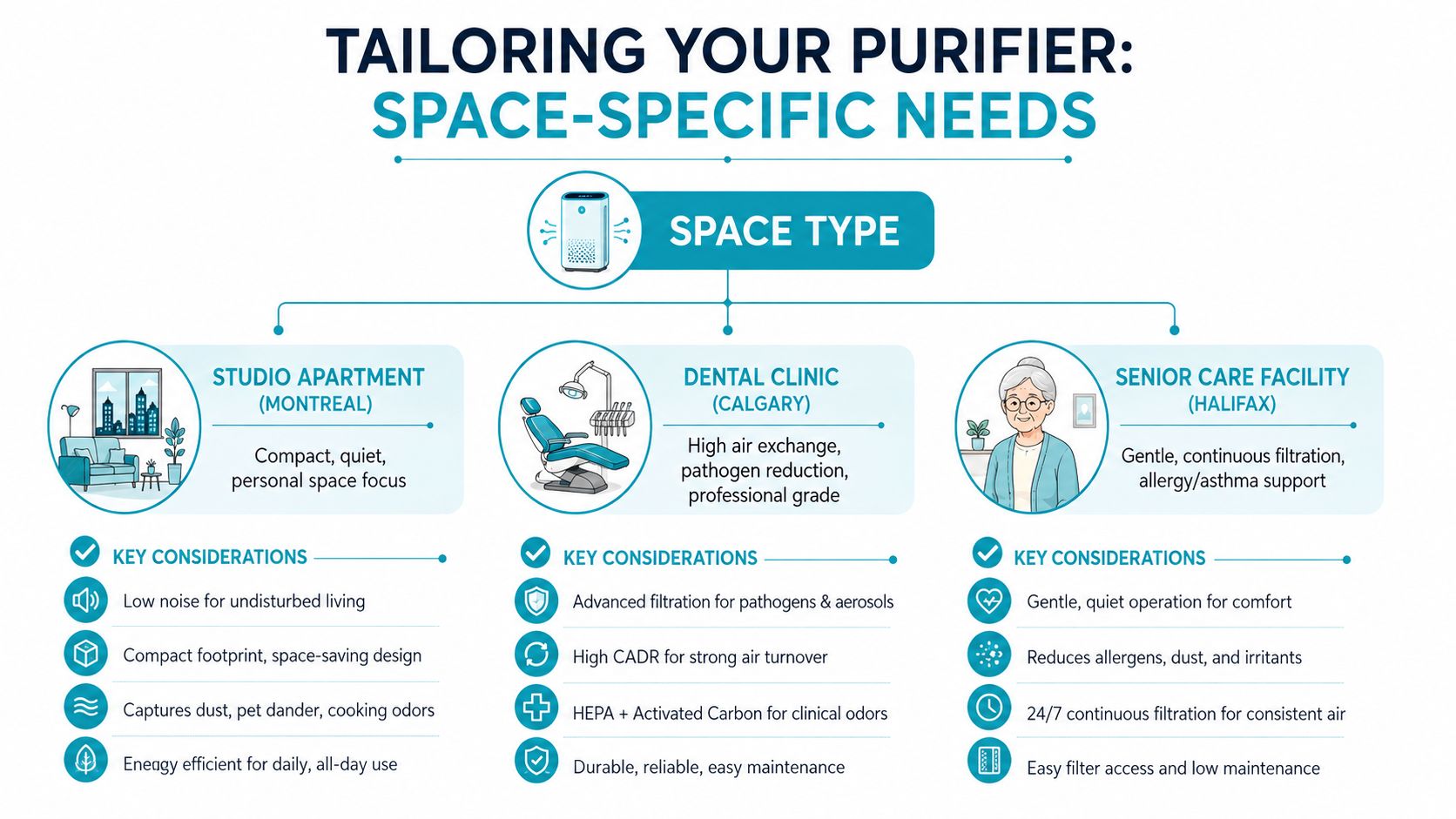
A purifier that works in one room can miss the mark in another. A quiet unit that sits well beside a bed may be a poor fit for a clinic waiting room, while a high-output model that makes sense in a larger living area can feel intrusive in a small office. The first question is not “Which model is best?” It is “What room am I trying to clean, and how hard is that room to keep clear?”
Bedrooms and studios favour quiet first
For a studio apartment or bedroom, the most useful specification is often low noise, not maximum output. That matters because a purifier that is irritating to hear tends not to stay on, and an unused purifier does nothing.
CADR measures the volume of clean air a purifier delivers, but in a bedroom the practical limit is often sound before airflow. A unit can be technically capable and still fail the ultimate test if it interrupts sleep or makes a small workspace feel busy.
Larger shared spaces need more clean-air muscle
A bigger living room or open-plan family space rewards stronger output. That does not make one larger system the right answer for every room, but it is a more credible fit when the goal is continuous purification across a broader area rather than bedside whisper-quiet operation.
The trade-off is simple. As room size and occupancy rise, a purifier has to move more air without becoming the loudest object in the room.
Practical rule: if the room is shared and occupied for long periods, the purifier has to stay quiet enough to blend into the background and strong enough to keep running there all day.
Clinics, senior care, and education need different thinking
Healthcare waiting rooms, senior care spaces, and classrooms change the brief again. The issue is not only comfort, it is steady filtration in spaces with more people and more exposure risk. For those environments, a consumer unit can be part of the answer, but facility managers usually need a system designed for broader deployment and more consistent operation.
The commercial planning logic behind Castus's air purification offering is relevant here because room-by-room sizing and scalable placement matter more than a feature list. That same approach carries over into settings where usage patterns vary from room to room and one undersized unit can leave a weak spot in coverage.
Match the device to the use case
Quiet bedrooms and offices: prioritise low-decibel operation and a size you will tolerate every night.
Open-plan homes: prioritise a higher-capacity unit that can keep up with shared air volume.
Clinics and care settings: prioritise scalable filtration and facility-level planning, not consumer convenience alone.
The biggest mistake is buying for the wrong room shape. A purifier that fits a tidy square bedroom may underperform in a long living room, and a strong tower may be too much for a desk. The room should set the requirements first, then the machine should be judged against them.
Total Cost of Ownership Beyond the Purchase Price
Sticker price is only the opening line in the budget. The true cost of an air purifier in Canada includes replacement filters, energy use, and the fact that smoke-heavy periods can load filters faster than a calm season. A cheap machine can be expensive to keep running if its filters are proprietary or short-lived, and a pricier machine can be easier to live with if maintenance is predictable.
Replacement filters change the economics
The broader maintenance lesson is simple. A purifier only works well if the filter stays in service, and Canadian wildfire smoke can push a filter towards replacement sooner than a low-pollution household would expect. That makes the filter ecosystem part of the purchase decision, not an afterthought. If a model has awkward or expensive replacement parts, the bargain can disappear quickly.
Energy and noise shape how often you actually run it
Machines that are efficient and quiet get used more consistently. That matters because a purifier that runs all day on a tolerable setting will usually outperform one that gets switched off because it hums too loudly or feels wasteful. In that sense, total cost includes the behavioural cost of annoyance, not just the line item on the receipt.
A useful way to think about this is to compare the purchase with the long tail of ownership:
Initial cost: what you pay on day one.
Filter cost: what you'll keep paying as the unit ages and catches smoke, dust, and household particles.
Usage cost: how often you're willing to run it because the noise and design don't get in the way.
Budget traps are usually maintenance traps
Budget units can look clever until replacement time arrives. Higher-end models can seem expensive until you realise they're the ones you're willing to leave running continuously, which is where purification happens. This is especially relevant in Canada, where wildfire seasons can turn a “good enough” filter into a short-cycle consumable.
Best value isn't the lowest sticker price. It's the model you'll keep maintaining without resenting it.
If you want a more operations-minded view of filter upkeep, the discussion at Castus's commercial filter replacement page is a practical reminder that long-term servicing is part of purification performance, not just a technical detail.
The conclusion is straightforward. A purifier's shelf price tells you very little about what it will cost to live with. In Canadian conditions, the cheapest option can become the most expensive one if it's hard to maintain, too loud to run, or too small for the job.
When Commercial-Grade Purification Makes Sense
Consumer purifiers are built for a room, not a facility. That distinction matters in clinics, assisted-living environments, classrooms, and corporate offices where occupancy, traffic, and risk don't stay constant from hour to hour. When the space is larger, and the air has to stay clean across multiple zones, commercial-grade planning starts to make more sense than a stack of standalone home units.
High-risk spaces need more than a single-box solution
Healthcare and senior care settings especially benefit from systems designed for continuous use and wider coverage. A purifier that works well in a bedroom can't always deliver the consistency required in a waiting room, hallway, or shared treatment area. Facility operators need scalable deployment, not just a machine with a good retail listing.
That's why multi-stage systems matter. Commercial units built around seven-stage purification are designed to layer filtration and sanitisation in a way that supports stricter indoor-air expectations. For operators, the value is in the system approach, because infection-control thinking is about reducing exposure across a whole environment, not winning a product comparison.
Budget and scale have to match the mission
Small clinics and early-learning centres often try to solve a building-scale problem with a consumer-scale budget. That can work temporarily, but it usually leaves coverage gaps or operational headaches. A right-sized commercial system can be easier to plan around because it aligns capacity, maintenance, and placement from the start.
If you're evaluating facility-level choices, the Castus article on reducing infection risk in healthcare facilities is a relevant resource because it frames purification as part of a broader infection-control approach rather than a standalone product purchase. That's the right lens for environments where staff, patients, residents, or students share air all day.
Facility rule: if one purifier can't maintain the whole space, the answer isn't to hope harder, it's to design the deployment properly.
There's also a reputational piece here. In senior care and healthcare, indoor air quality affects trust as much as comfort. In education, it affects concentration and consistency. In corporate workplaces, it affects whether people feel good about spending long hours indoors.
Commercial-grade purification isn't for every address, but it is the right answer when the room is no longer just a room. It becomes part of an operating environment, and that changes the standard.
Your Decision Framework for Choosing the Best Air Purifier
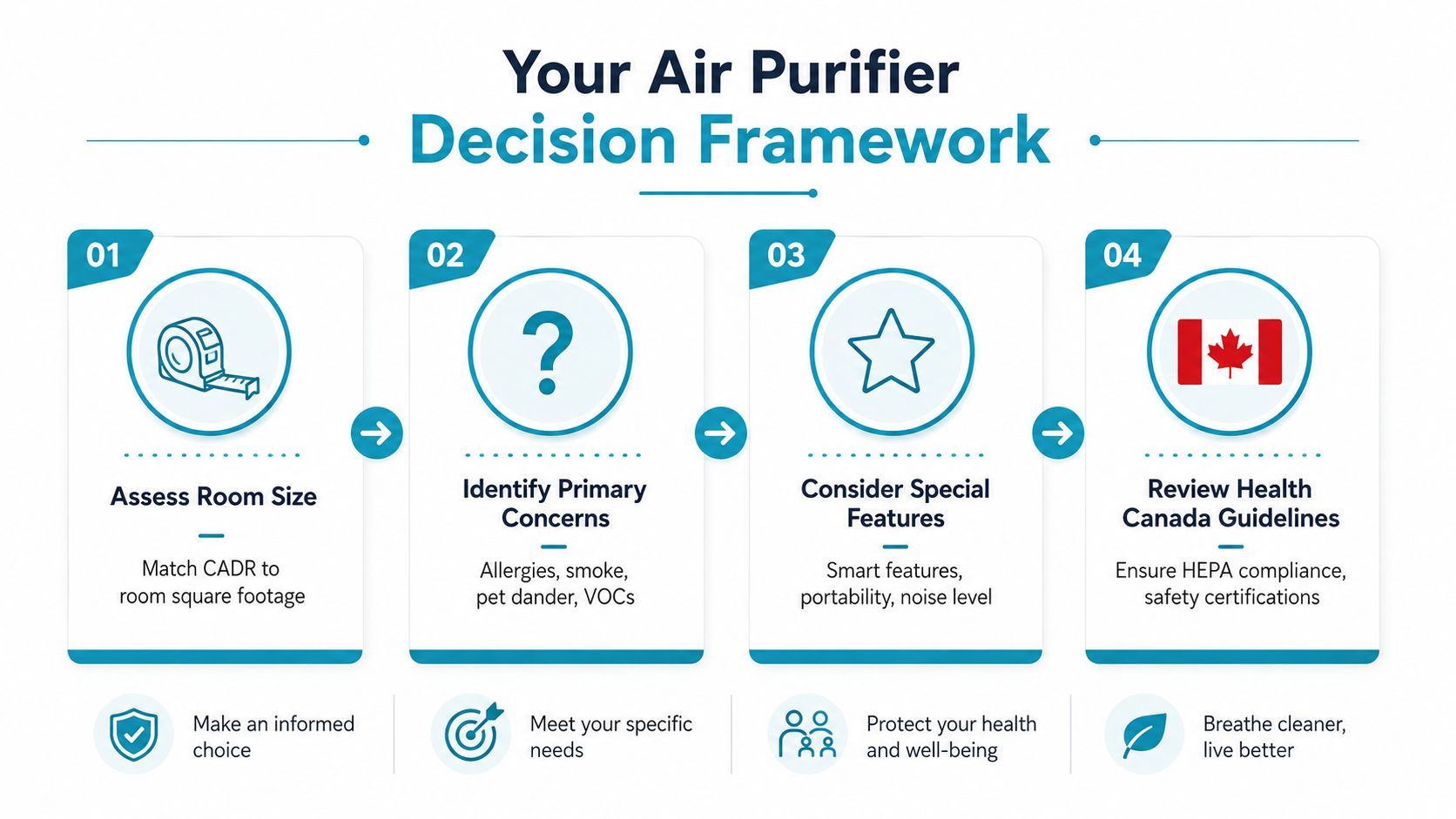
The quickest way to narrow the field is to start with the room, not the brand. Measure the space, decide what problem you're solving, then compare the purifier's CADR, noise, and filter type against that real use case. That order prevents most bad purchases before they happen.
Use a simple four-step filter
Assess room size. Match the purifier's clean-air output to the actual space, not the marketing description.
Identify the main pollutant. Smoke, allergies, pet dander, and general dust push you towards slightly different priorities.
Check the sound level. If the machine is too noisy for sleep or work, it won't stay on long enough to help.
Verify the filter standard. Health Canada's guidance supports true HEPA and proper room matching, so that's the baseline to hold.
Separate bedroom logic from smoke logic
A quiet compact unit makes sense if your main priority is sleeping through the night without hearing the fan. A larger-output purifier makes more sense if wildfire smoke or a bigger shared room is the issue. That difference is the whole game, because the wrong purifier often fails by being technically fine and practically wrong.
Decide with maintenance in mind
Think beyond the purchase. If the filter replacement schedule, noise, and footprint don't fit your habits, you'll stop using the purifier the way it was designed to be used. The best choice is the one you can keep running without fiddling with it every day.
If you're comparing options for a home, clinic, or workplace and want a Canadian supplier that works across purification and hygiene categories, Castus offers scalable air purification products, filters, and support for different facility sizes. Visit them if you want to pair room sizing with a practical purchasing path, especially when your indoor-air needs go beyond a single bedroom unit.
